Management And Oversight: Should CEOs Sit On The Board?
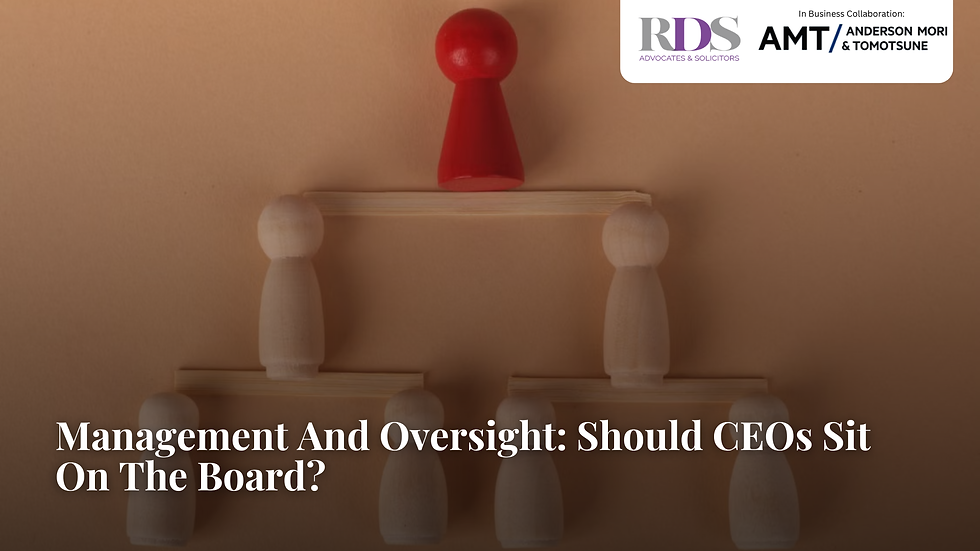
As a result of recent corporate scandals, authorities, reformers and investors have called for companies to adopt a straightforward principle: there must be a clear distinction between the roles of management and oversight. While this separation of powers is intended to promote accountability, modern corporations rarely operate within such clear distinctions.
By direction of the board, an organisation’s top executive staff, typically the Chief Executive Officer (CEO), is responsible for the management of all aspects of the organisation. Given this central role, it is unsurprising that, rather than keeping the CEO in a strictly managerial position, some boards award them a role in governance as well, offering the CEO a seat on the board.
Although this arrangement may improve information flow and strategic alignment, it also raises important governance concerns. The board's role is to supervise management, evaluate performance and challenge assumptions where necessary. When the CEO sits as a member of the board, the lines between oversight and management can become blurred, creating situations of conflict, tensions between operational involvement and independent scrutiny.
The Growing Emphasis On Independent Oversight
It must be recognised that Malaysian corporate governance frameworks and regulations have long placed strong emphasis on the board’s role of independent oversight. For example:
Section 211(1) of the Companies Act 2016 (CA 2016):
The board has all the powers necessary for supervising the management of the business and affairs subject to the Act or the constitution of the company.
Section 215(2) of CA 2016:
A reliance on information provided by others by a director in exercising his duties is only reasonable if it is made in good faith and after making an independent assessment of the information having regard to the director’s knowledge of the company and the complexity of the structure and operation of the company.
Practice 1.1 (read together with Guidance 1.1) of the Malaysian Code on Corporate Governance (MCCG):
The board is required to regularly review, monitor and challenge the management’s proposals, and supervise and assess management performance.
Practice 1.3 of the MCCG:
The positions of Chairman of the board and CEO must be held by different individuals.
Guidance 1.3 of the MCCG:
Outlines that the responsibilities of the Chairman should be leading the board in its collective oversight of management, while the CEO focuses on the business and day-to-day management of the company.
Practice 5.2 of the MCCG:
At least half of the board comprises independent directors. For large companies, the board comprises a majority independent directors.
Notwithstanding, these regulations have not prohibited CEOs from serving on the board. In fact, managing directors, i.e. a CEO who sits as a member of the board, have long formed part of the governance structure of many listed companies.
However, corporate governance developments over the last decade such as the MCCG, suggest a growing emphasis on a clearer distinction between management and the board. In particular, the latest revision added the lines onto Guidance 1.1: “Where the CEO or executive directors form part of the board, the non-executive directors are encouraged to meet among themselves at least annually to discuss among others strategic, governance and operational issues.”
Furthermore, in the financial sector, Bank Negara Malaysia (BNM) has adopted an even more prescriptive approach through its Corporate Governance Policy Document for licensed financial institutions, which deliberately limits executive representation on boards to no more than one executive director, unless BNM had approved it in writing subject to requirements. While these requirements are sector-specific, they reflect a broader regulatory philosophy that effective oversight is best achieved where boards remain institutionally independent from management.[1]
Both the MCCG and BNM’s Corporate Governance Policy Document stops short of discouraging CEOs from serving as a director, yet these regulations offer a potential glimpse into the future of board governance; it reflects a recognition that the presence of the CEO may influence the dynamics of board discussions and potentially inhibit the ability of directors to engage in independent and candid deliberations and perhaps may affect the board’s overall independent decision-making capabilities.
This direction of change may likely continue. In July 2025, the Securities Commission (SC) announced that an updated MCCG, with a focus on board effectiveness and strengthening the board's role in long-term value creation, would be issued in 2026 and indicated that certain governance practices may become mandatory where necessary to improve governance outcomes.
While the MCCG 2026 remains subject to consultation, the emphasis on board effectiveness is noteworthy. Increasingly, regulators seem to be moving towards questions of board behaviour and decision-making quality. In this evolving regulatory landscape, the debate on whether CEOs should sit on the board remains open, and the question is now whether boards have sufficient safeguards in place to ensure that their presence does not affect independent oversight.
CEOs On The Board
When CEOs are part of the wider senior management team, their close contact with key authorities, such the general or in-house counsel and the chief operating officer, gives CEOs first-hand knowledge and the inside perspective on all aspects of the business.
In short, CEOs are a key authority figure “on the ground”. As boards are responsible for monitoring performance, overseeing risk and evaluating management, any board that does not have its CEO at a board meeting is depriving itself of arguably its greatest resource in terms of informing it of operational or managerial realities.
CEOs’ presence on the board could improve communication between senior management and directors and reduce information gaps, which enables directors to obtain immediate clarification on complex issues rather than relying solely on management reports. From this perspective, excluding CEOs entirely from the board may risk creating an unnecessary disconnect between governance and execution, especially when oversight depends on access to accurate and timely information.
It must also be especially emphasised that this information gap may risk the board becoming unable to carry out its duties and responsibilities as required by Malaysian corporate governance frameworks or authorities. For instance:
Guidance 1.3 of the MCCG:
Boards should understand principal business risks and recognise that business decisions require appropriate risks, ensure effective stakeholder communication, and ensure that all directors possess the financial literacy needed to evaluate financial statements.
Section 213(2) of CA 2016:
Directors are required to exercise reasonable care, skill and diligence.
Section 214(1) of CA 2016:
A director meets their duty of care if a business judgment is made in good faith, for a proper purpose, and based on a reasonably appropriate level of information.
Ultimately, a CEO who participates effectively can enable directors to make better-informed decisions by bridging the information gap, which strengthens the board’s effectiveness, quality and its position as an overseer.
Information vs Independence
Again, the board's primary responsibility is governance and oversight. When the CEO sits on the board, the distinction between overseer and overseen becomes less clear and may blur institutional boundaries that are intended to preserve accountability.
This does not suggest that CEOs are incapable of acting objectively or that they will necessarily behave improperly. Rather, the issue is whether governance structures are designed to anticipate potential conflicts and preserve objectivity. As an example, when boards consider matters involving a CEO’s performance, remuneration and succession planning, these discussions may become more difficult when the subject of evaluation is also present within the governing body conducting the assessment.
The same philosophy is already reflected elsewhere. For example, the MCCG prohibits the Chairman to sit on any board committees in order to avoid self-review. The concern is not that Chairmen cannot contribute meaningfully, but that their presence may affect the committees' ability to exercise independent judgment. The same governance rationale may equally inform discussions on whether CEOs should sit on the board. If governance structures seek to minimise situations where oversight functions overlap with those subject to oversight, then the CEO's dual role as both manager and director similarly warrants careful consideration.
Even with safeguards such as Practice 5.2 of the MCCG, the CEO may influence boardroom discussion and potentially discourage robust challenge from other directors, which further amplifies the potential risk of boardroom factionalism when directors start picking sides on alignment with the CEO, while independent directors become increasingly isolated in exercising objective oversight. This not only results in poor decision-making, but also a gradual erosion of the healthy gap that should exist between the board and management when considering that CEOs hold a more managerial position rather than an oversight one.
Furthermore, many of the advantages associated with having the CEO on the board become insignificant when CEOs can attend board meetings as invitees where they can respond to directors' questions whenever necessary without becoming board members. This enables the board to benefit fully from the CEO's expertise and institutional knowledge while preserving a clearer distinction between management and oversight and without diverting the CEO’s attention away from his managerial duties.
In short, the incremental governance value of the CEO sitting as a director can be said to be limited when the governance risks arising from blurred roles and diminished independence remain.
The True Keys To An Effective Board
Research has shown that the participation of CEOs in the board does not necessarily influence operations, management oversight, or executive compensation.[2] It seems that board effectiveness often depends less on ‘board structure’ and more on ‘board culture’. As such, organisations should consider what and how boards should leverage a sitting CEO’s management expertise in their decision-making.
A strong board is capable of benefiting from management insight while maintaining independent oversight. Such boards encourage constructive challenges, robust debate and open discussion, regardless of hierarchy or position. Conversely, a weak board magnifies the risks associated with CEO board membership. Directors may become reluctant to challenge management; discussions may become overly management-driven and difficult issues may receive insufficient scrutiny.
In these circumstances, the issue is not necessarily the CEO's presence on the board itself, but whether boards can retain the capacity and willingness to exercise independent judgment. Therefore, boards should adopt practical measures to address this, which may include:
ensuring proper corporate governance and compliance.
maintaining a majority of truly independent directors.
having the courage to ask the tough questions and provide constructive challenge to management
implementing board evaluation processes.
maintaining clear protocols for conflicts of interest and abstentions.
Conclusion
All in all, there is no universal answer to whether CEOs should be part of the board. The appropriate approach ultimately depends on the company's circumstances, governance structure, and strategic needs. For some companies in other jurisdictions, CEO participation contributes positively to future operating performance, decision making, or the monitoring of management by the board. For others, it creates inherent tensions between management and oversight that must be carefully managed. Some companies in the United States, for example, have even attempted to address this by appointing retired CEOs who have the same strategic and leadership experience as current CEOs but without the usual responsibilities.[3]
However, the true challenge for modern boards is ensuring that the presence of management does not compromise the board's ability to provide independent challenge, objective oversight and effective governance.
Ultimately, good governance is not necessarily achieved when management and oversight are separated entirely, or by merging the two without adequate safeguards. It is achieved when the balance between them is carefully preserved. After all, it is not about who occupies a seat in the boardroom, but whether the board itself has the independence, objectivity, and courage to ask the difficult questions.
[1] Section 11.4, Corporate Governance Policy Document, Bank Negara Malaysia
[2] https://www.strategy-business.com/article/re00041 & Why Do Firms Appoint CEOs as Outside Directors? Fisher College of Business Working Paper No. 2008-03-009
[3] Chairman and CEO; The controversy over board leadership structure, Stanford Closer Look Series; https://www.gsb.stanford.edu/sites/default/files/publication-pdf/cgri-closer-look-58-independent-chair.pdf
29 July 2026